

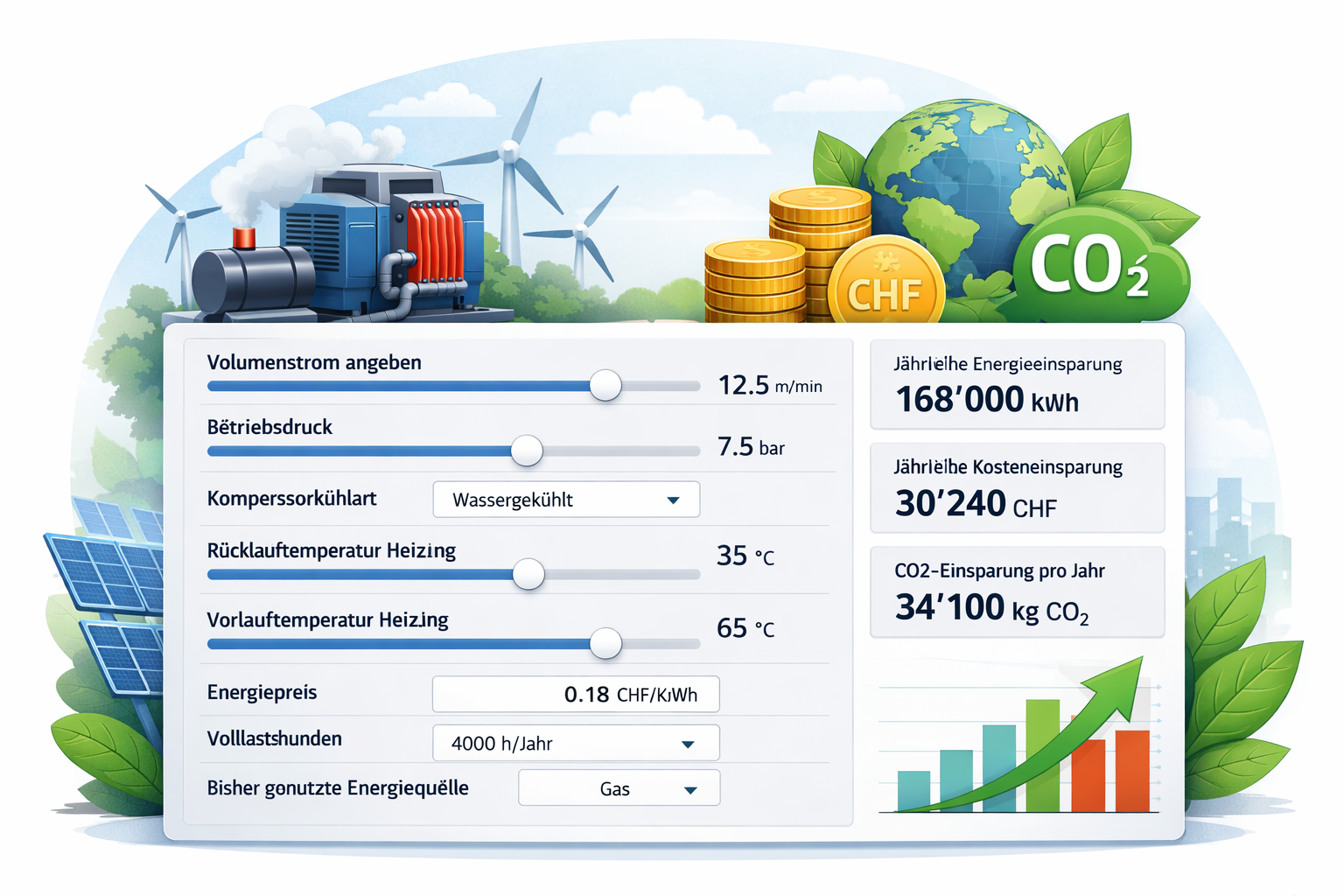
Use your compressor’s waste heat as a valuable source of energy. With modern heat recovery, you can lower your energy costs for the long term, reduce your CO2 emissions and at the same time increase the efficiency of your operation.
This calculator determines the annual savings potential from recovered heat: energy (kWh), costs (CHF) and CO2.
Why saving energy and resources matters more today than ever
Energy efficiency has long ceased to be a “nice-to-have”. It is a tangible competitive factor – and at the same time one of the most effective levers for reducing environmental impact and CO2 emissions. Investing in savings now reduces running costs, strengthens planning certainty and makes the business future-proof.
Energy prices: volatility remains, planning certainty becomes more important
In recent years, many companies have experienced how much energy prices can fluctuate. Even when market prices ease at times, the drivers of increased cost pressure remain: rising electricity demand (e.g. due to electrification), necessary grid investments, as well as geopolitical risks and dependence on raw materials. The International Energy Agency continues to expect strong growth in electricity demand through to 2030.
That is exactly why it pays to reduce consumption permanently: every kWh saved reduces dependence on price movements.
Environment & sustainability: expectations are rising
Sustainability today is more than an image issue. Customers, employees, investors and partners are paying increasing attention to how companies handle energy and resources. At the same time, science clearly shows that rapid emission cuts are necessary to limit global warming. The IPCC stresses that this requires “deep, rapid and sustained” emission reductions in all sectors.
Companies that implement efficiency projects can also make this impact measurable – and thus communicate it credibly.
Stricter targets: CO2 reduction becomes mandatory
Regulations and targets are being tightened in many countries and industries. The EU has enshrined the goal of reducing greenhouse gas emissions by at least 55% compared with 1990 by 2030 (“Fit for 55”), on the path to climate neutrality by 2050.
Switzerland is also pursuing clear climate targets: the net zero target for 2050 is enshrined in the Climate and Innovation Act, which came into force in 2025.
This means that CO2 is increasingly being taken into account in planning, reporting and investment decisions. Efficiency not only lowers costs but also reduces the pressure from requirements and reporting obligations.
Credit: images from Pexels, blog image by ChatGPT