DRYPOINT® AC 410-495 / HL
reliable, innovative and safe
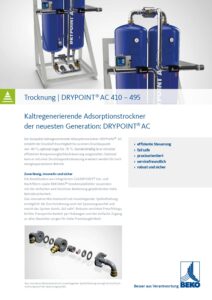
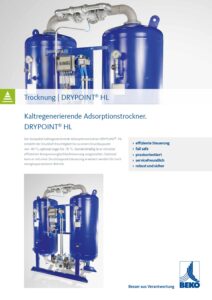
The desiccant dryers of the DRYPOINT AC 410-495 and DRYPOINT HL series use high-quality desiccant to ensure a stable supply of high-quality compressed air. The desiccant removes moisture from the compressed air down to a pressure dew point of -40 °C, optionally down to -70 °C. This ensures smooth and economical production processes.
Pressure dew point
down to −40 °C
Optional dew point
down to −70 °C
Regeneration
heatless
Filter
CLEARPOINT integrated
Efficient pressure dew point control for optimised operating costs in the DRYPOINT AC 410-495
The pressure dew point control and the compressor synchronisation control exploit the potential savings particularly efficiently and significantly reduce operating costs.
The innovative changeover valve of the DRYPOINT AC 410-495 with internal purge air line allows air to flow even in the event of a power failure, making the system ‘fail safe’. Robust galvanised press fittings, easy transport by pallet truck and simple access to all components make it highly practical.
The combination of integrated CLEARPOINT pre- and after-filters and BEKOMAT condensate drains, together with simple and intuitive operation, ensures high operational reliability for both the DRYPOINT AC 410-495 and the DRYPOINT HL.
How the DRYPOINT® AC / HL works
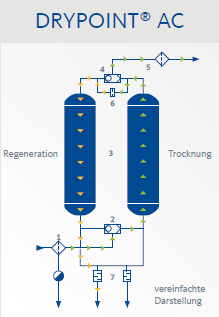
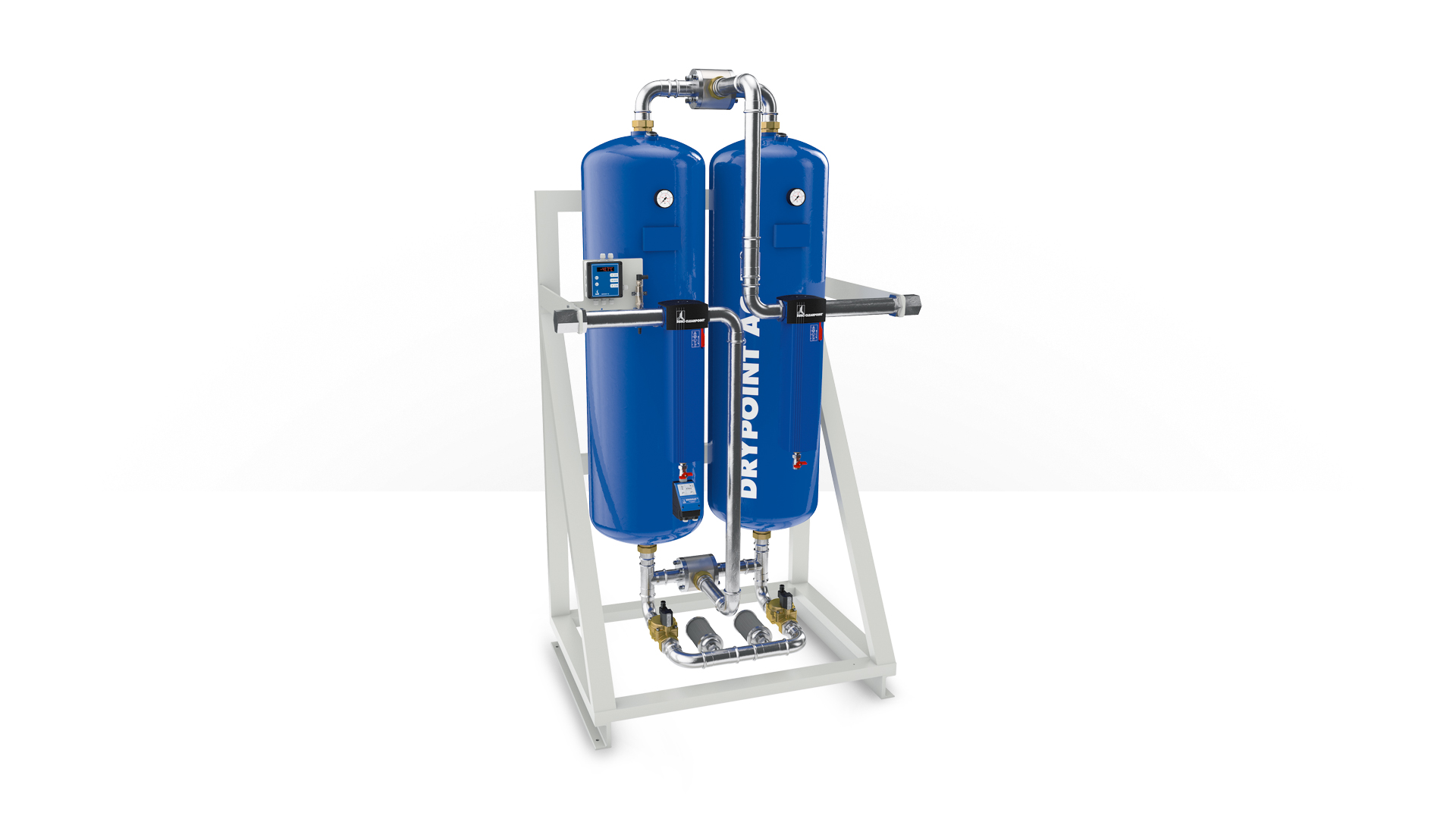
The heatless desiccant dryer DRYPOINT AC ensures a continuous supply of high-quality compressed air. Two vessels filled with desiccant (3) are arranged in parallel. The compressed air passes through the CLEARPOINT pre-filter and the BEKOMAT condensate drain (1), which remove particles and condensate, and through the lower changeover valve (2) into the adsorption vessel (3). There it is dried to the required degree of dryness (pressure dew point). It then flows through the upper changeover valve (4) and a CLEARPOINT after-filter (5), which retains any desiccant dust. The dried and cleaned air is then available for use. While the compressed air is being dried in one vessel, the desiccant in the other is regenerated at the same time. For this purpose, a partial flow of already dried air is expanded to atmospheric pressure via a nozzle (6), passed over the desiccant bed for regeneration and released to atmosphere via a silencer (7). Switching between the two vessels is time-controlled in a fixed cycle, or optionally dew-point-dependent. The dew point reading can of course optionally be passed on to a data logger such as the METPOINT BDL.
* Further technical data can be found in the product information in the download section below…
Advantages of the DRYPOINT® AC / HL
Economical
- low operating costs thanks to extremely low differential pressure
- energy savings through compressor synchronisation control
- PDP control (optional) reduces operating costs even further
- loss-free, reliable condensate drainage with BEKOMAT
Robust and safe
- reliable separation with CLEARPOINT filters
- simple filter monitoring thanks to newly developed filter management
- fail-safe: air keeps flowing even during a power failure thanks to an innovative changeover valve
- pressure gauge for pressure monitoring
Practical
- easy to service thanks to easy access to all components
- easy transport by pallet truck
- robust galvanised press fittings
- small footprint thanks to compact design
Frequently asked questions
What pressure dew point do the DRYPOINT AC 410-495 and HL achieve?
The desiccant dries the compressed air down to a pressure dew point of −40 °C. Down to −70 °C is possible as an option.
How does the DRYPOINT AC work?
Two vessels filled with desiccant work in parallel. In one, the compressed air is dried; in the other, the desiccant is regenerated with a partial flow of already dried, expanded air.
When does the dryer switch between the vessels?
As standard, time-controlled in a fixed cycle. Optionally, switching is dew-point-dependent.
How does the dryer keep operating costs low?
The differential pressure is extremely low, and the compressor synchronisation control saves energy. The optional pressure dew point control reduces operating costs even further.
What happens in the event of a power failure?
The changeover valve with internal purge air line lets the compressed air flow even during a power failure. This makes the system fail-safe.
Which filters and condensate drains are built in?
CLEARPOINT pre- and after-filters and a BEKOMAT condensate drain are integrated. The after-filter retains any desiccant dust, and the BEKOMAT drains the condensate without loss.
Can the dew point be recorded?
Yes. The dew point reading can optionally be passed on to a data logger such as the METPOINT BDL.
How much effort do installation and maintenance require?
The dryer is compact and can be moved by pallet truck. All components are easily accessible, and filter management makes filter monitoring easier.
Who can help me choose the right model?
We can. Pressure dew point and flow rate depend on compressor output and application, and we will find the right model with you. Call or write to us.
Which dryer suits your application?
There are various pressure dew points and flow rates, which vary depending on compressor output and field of application and must be taken into account. Let us advise you to find the optimum model for your needs.