

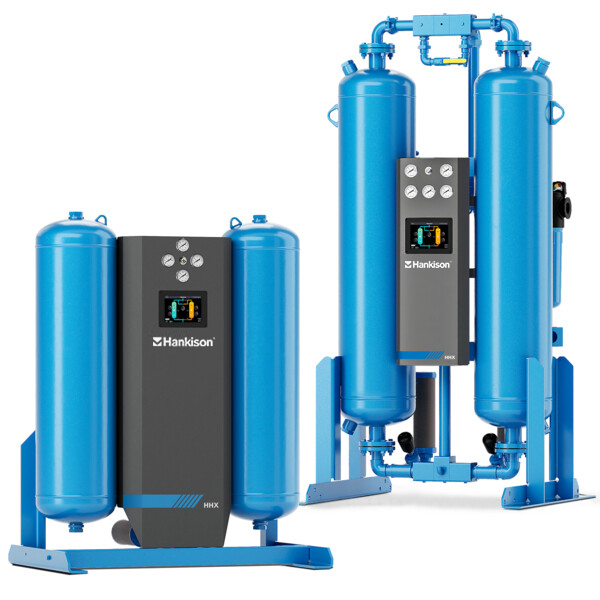
Hankison HMW Series
Electrically heated desiccant dryer
HMW Series desiccant dryers are a robust solution for demanding industrial applications. With an air flow of 254 m³/h to 4,280 m³/h and available in standard 10 bar versions with an optional upgrade to 16 bar, this series covers a wide range of operating requirements. The dryers are equipped with an innovative internal heat recovery system that reduces operating costs and maximises energy efficiency through an economical regeneration process. Additional benefits such as dew point control for further energy savings, mechanically stable and low-dust desiccant for a longer service life, and included inlet and outlet filters make the HMW desiccant air dryer the ideal choice for efficient and durable air drying in your production environment.
Flow rate
245 to 4,280 m³/h
Pressure
10 bar, opt. 16 bar
Power
Ø 1.7 to 22.5 kW
Energy saving
up to 80 % (with EMS)
HMW Series: regeneration with electric heating in the desiccant bed
HMW Series desiccant dryers improve the regeneration of saturated desiccant by means of electric heaters integrated directly into the desiccant bed. This configuration ensures that regeneration energy is used optimally through direct contact of the finned heating tubes with the desiccant. A small portion of the compressed air flow is used to extract moisture from the desiccant and cool it, so that the regeneration process is not affected by external factors. A simultaneous drying phase during the cycle changeover prevents any fluctuations in temperature or dew point.
The optional energy management system (EMS) allows the standard drying time per cycle to be extended from 4 to as much as 20 hours, which can result in energy savings of up to 80%.
HMW Series desiccant dryers operate under a wide range of operating conditions and are designed for extreme conditions. According to ISO 7183, standard operating conditions include a working temperature of 35°C and an operating pressure of 7 bar gauge. Higher temperatures or lower operating pressures require an adapted adsorption and regeneration capacity. The regeneration output should also adapt automatically to the reduced adsorption requirement during periods of reduced operation, such as at night, at weekends or in winter.
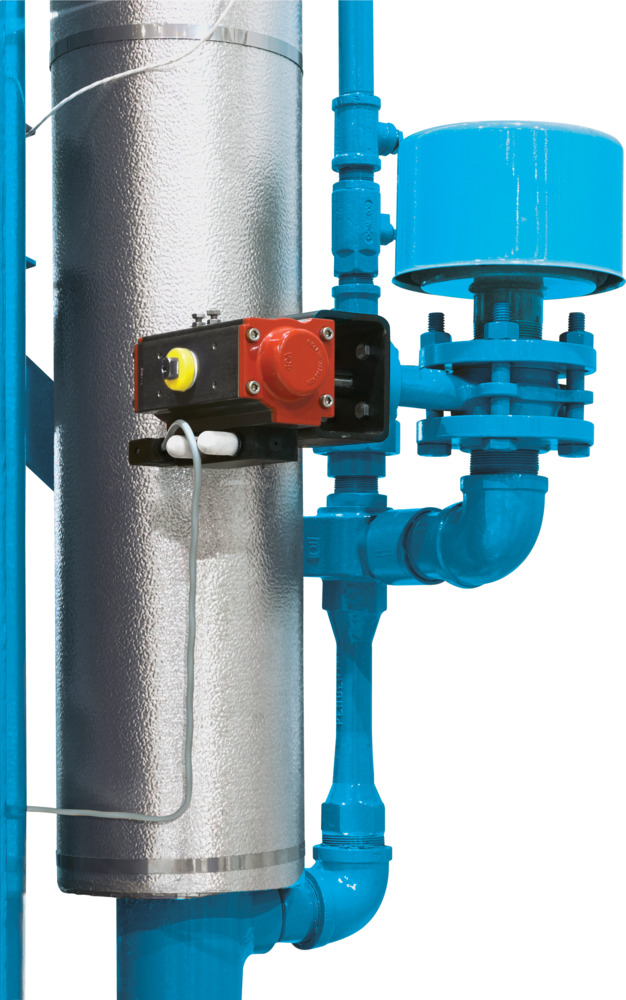
Efficient and reliable desiccant dryers for industrial applications
- Optimised regeneration: the use of electric heaters directly in the desiccant bed ensures efficient use of regeneration energy.
- Direct contact: the finned heating tubes, in direct contact with the desiccant bed, maximise the transfer of regeneration energy, increasing efficiency.
- Reliable processes: the drying process is designed so that environmental pollution or moisture does not affect the regeneration process.
- Stable operating conditions: a parallel drying phase during the cycle changeover prevents temperature or dew point fluctuations, resulting in constant performance.
- Energy savings: the optional energy management system allows the standard drying time to be extended from 4 to as much as 20 hours, enabling energy savings of up to 80%.
- Flexibility under various operating conditions: according to ISO 7183, the dryers are designed for a working temperature of 35°C and an operating pressure of 7 bar, but can be adapted to higher temperatures or lower pressures.
- Adaptability in reduced operating phases: the regeneration output adapts automatically to reduced operating conditions, saving energy and increasing efficiency.
Specifications
| Model | Flow rate* | Connection | Operation | Control | Power consumption (kW) | Pre-filter | After-filtration | |
|---|---|---|---|---|---|---|---|---|
| m3/h | V/Ph/Hz | Average | Installed | |||||
| HMW 74 | 245 | 1″ | 400/3/50 | 95-230/1/50 | 1.7 | 3.6 | F08-B-HF | DF08-HTA |
| HMW 120 | 400 | 1 1/2″ | 2.7 | 5.4 | F12-B-HF | DF12-HTA | ||
| HMW 196 | 653 | 1 1/2″ | 3.6 | 7.2 | F12-B-HF | DF12-HTA | ||
| HMW 236 | 785 | 2″ | 4.5 | 9.0 | HF5-52 | HF6-52HTA | ||
| HMW 308 | 1,026 | 2″ | 5.4 | 10.8 | HF5-56 | HF6-56HTA | ||
| HMW 385 | 1,282 | DN 80 | 7.2 | 14.4 | H F5-56 | HF6-56HTA | ||
| HMW 575 | 1.916 | DN 80 | 10.8 | 21.6 | HF5-56 | HF6-56HTA | ||
| HMW 675 | 2,250 | DN 80 | 12.6 | 25.2 | H F5-60 | H F6-60HTA | ||
| HMW 801 | 2,670 | DN100 | 14.4 | 28.8 | HF5-60 | HF6-60HTA | ||
| HMW 1077 | 3,590 | DN100 | 18.9 | 37.8 | HF5-64 | HF6-64HTA | ||
| HMW 1284 | 4,280 | DN100 | 22.5 | 45.0 | HF5-68 | HF6-68HTA | ||
*ISO 7183, based on the compressor intake volume at +20°C and bar (a), operating pressure 7 bar (g), inlet temperature 35°C, ambient or cooling water temperature 25 °C, pressure dew point -40 °C.
Frequently asked questions
How does regeneration work in the Hankison HMW Series?
Electric finned heating tubes sit directly in the desiccant bed and transfer the regeneration energy through direct contact. A small part of the compressed air flow carries away the moisture and cools the desiccant down again.
What air flows does the HMW Series cover?
According to the specification table, from 245 m³/h for the HMW 74 to 4,280 m³/h for the HMW 1284.
What operating pressure is the series designed for?
10 bar as standard, 16 bar as an option.
How much energy can be saved?
With the optional energy management system (EMS), the drying time per cycle is extended from 4 to as much as 20 hours. This can save up to 80 % of energy.
What is the power consumption?
On average between 1.7 kW for the HMW 74 and 22.5 kW for the HMW 1284. The installed power is 3.6 to 45.0 kW.
Does the dew point fluctuate when the vessels change over?
No. A parallel drying phase during the cycle changeover prevents fluctuations in temperature and dew point.
What should be considered when operating conditions differ?
The design applies to an inlet temperature of 35 °C and 7 bar gauge pressure in accordance with ISO 7183. Higher temperatures or lower pressures require an adapted adsorption and regeneration capacity.
How durable is the desiccant?
The desiccant is mechanically stable and low in dust, which extends its service life. Inlet and outlet filters are included.
Who can help me choose the right model?
We can. We clarify the flow rate, pressure dew point and compressor output with you and select the right model. Call us or write to us.
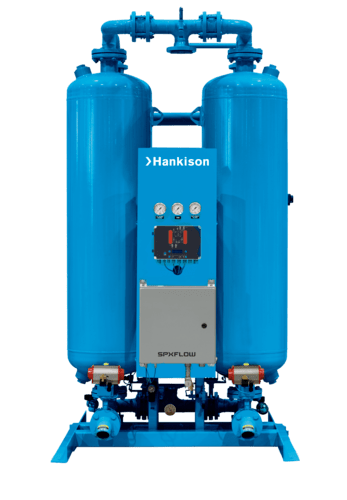
Which dryer suits your application?
There are various pressure dew points and flow rates, which vary depending on compressor output and field of application and must be taken into account. Let us advise you to find the optimum model for your needs.