

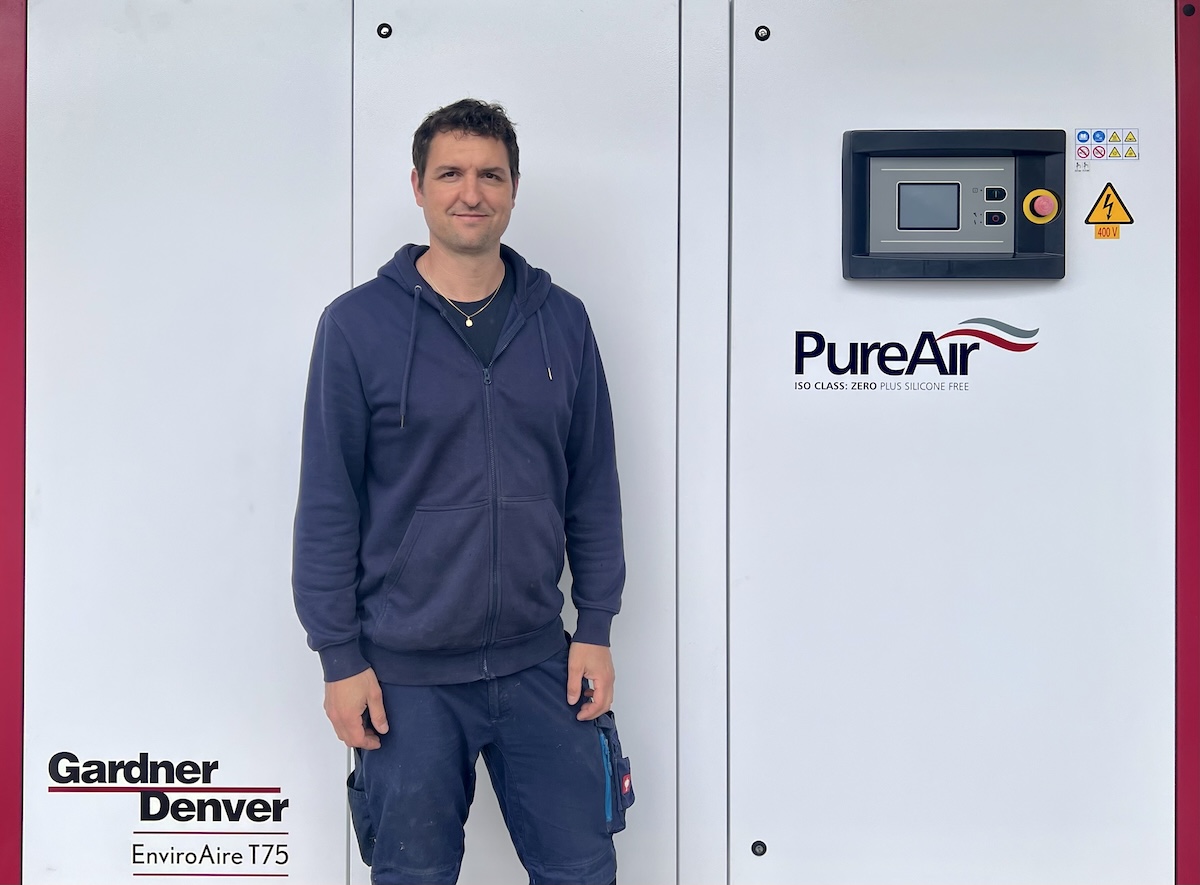
Understanding, measuring and operating compressed air efficiently – interview with Dominik Zumsteg
Compressed air is one of the most expensive forms of energy in industry – and at the same time one of the least transparent. Many systems have grown over time and are rarely questioned in day-to-day operations. In this interview, Dominik Zumsteg explains why sound measurement data is the key to greater efficiency and how hidden losses can be uncovered systematically.
Dominik, many companies know that compressed air is expensive. Yet often little is done about it. Why is that?
This is often due to a lack of transparency. Compressed air is everywhere in a plant, but its actual use is rarely recorded in detail. Without real data, it is difficult to judge whether a system is operating efficiently or not. In many cases, people rely on empirical values or safety reserves, with the result that systems are permanently oversized or operated inefficiently.
You often say that you have to measure first. What does that mean in concrete terms?
In concrete terms, it means measuring the flow rate in the system and recording it over a certain period. That is the only way to understand how the actual compressed air demand behaves in operation. These load profiles are crucial for matching generation sensibly to consumption. Without this basis, there is a risk that compressors run permanently at partial load or with unnecessary reserves.
What can typically be derived from such measurements?
A great deal. For example, you can see whether there are pronounced load peaks or whether consumption is relatively constant. It also becomes apparent whether compressed air continues to be drawn outside production hours – which is often a sign of leaks. Such findings are key to optimising compressor control and designing the overall system more efficiently.
Leaks are a well-known issue. What is the biggest challenge here?
The challenge is that many leaks go undetected for a long time. They develop gradually and in their early stages are neither visible nor audible. That is precisely why it is not enough to rely on your hearing. We make targeted use of ultrasonic measuring instruments that can detect even the smallest leaks before they become audible.
How does ultrasonic leak detection work in practice?
Escaping compressed air generates characteristic ultrasonic frequencies at the point of a leak. These lie outside the audible range but can be reliably picked up with suitable measuring instruments. This allows leaks to be located very precisely. The big advantage is that you can proceed systematically rather than relying on chance or obvious noises.
What role does the combination of measurement and leak detection play?
The two complement each other perfectly. Flow measurement shows how high total consumption is and how it is distributed over time. Leak detection then goes a step further and identifies specific points of loss in the system. Only this combination provides a complete picture from which targeted measures can be derived.
Where do you see the greatest savings potential in practice?
The greatest potential usually lies in the sum of many individual measures. These include reducing leaks, adapting the system pressure to actual demand and optimising compressor control. What matters is that these measures are not considered in isolation but always in the context of the entire system. In addition, simple measures such as an Air Saver can reduce energy costs quickly and inexpensively.
Note: We have already presented the Air Saver in this blog post.
What distinguishes a thorough analysis from a quick optimisation?
A thorough analysis is based on real operating data and looks at the system as a whole. It is not just about improving individual components, but about understanding how all the elements interact. Quick optimisations can help in the short term but often fall short if the fundamental relationships are not taken into account.
What would you advise a company that wants to reduce its compressed air costs sustainably?
The first step is always to create transparency. Those who know and understand their consumption can take targeted action. The combination of flow measurement and modern leak detection creates the transparency needed to uncover hidden losses and reduce them in a targeted way.
Building on this, the system should be reviewed and adjusted regularly. Compressed air is not a static topic – requirements change, and the system should therefore be continuously reviewed and optimised accordingly.