

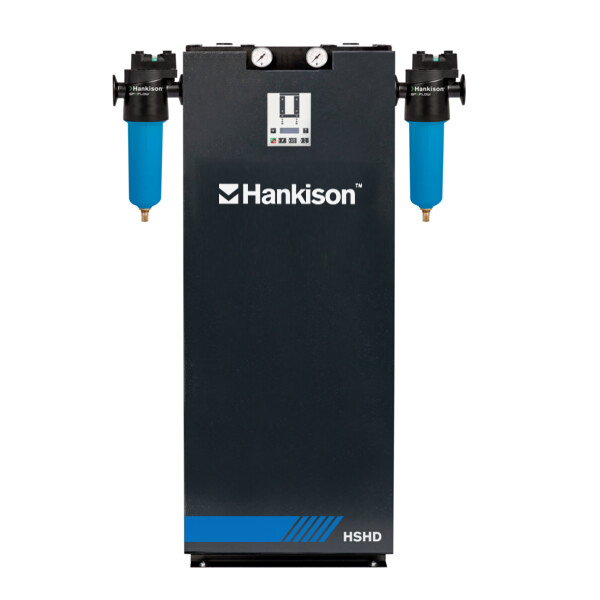
Hankison HSHD Series
Modular heatless desiccant dryers
The modular HSHD Series desiccant dryers, with an air flow of 8m³/h to 68m³/h, are perfectly suited for use directly at the point of use, in laboratories and other confined areas. They ensure a reliable supply of dry compressed air by automatically and cyclically passing the air flow through two desiccant beds to achieve optimum results.
Flow rate
8 to 68 m³/h
Pressure dew point
−40 °C or −70 °C
Connection
½″ NPT
Design
modular
The HSHD Series: reliable desiccant dryers for demanding applications
The compact and user-friendly modular HSHD Series desiccant dryers from Hankison not only offer robust communication but are also CSA/UL certified and CRN registered. Developed and tested in Germany, these units are ideal for moisture-sensitive applications requiring low pressure dew points. They achieve dew points in accordance with ISO 8573-1: 2010 Class 1 (-70°C) and Class 2 (-40°C) and offer flow rates of 7 to 40 scfm (12m³/h to 68m³/h).
The versatile HSHD is the ideal choice for laboratories, hospitals, pharmaceutical production and other demanding high-tech environments that require maximum performance and reliability.
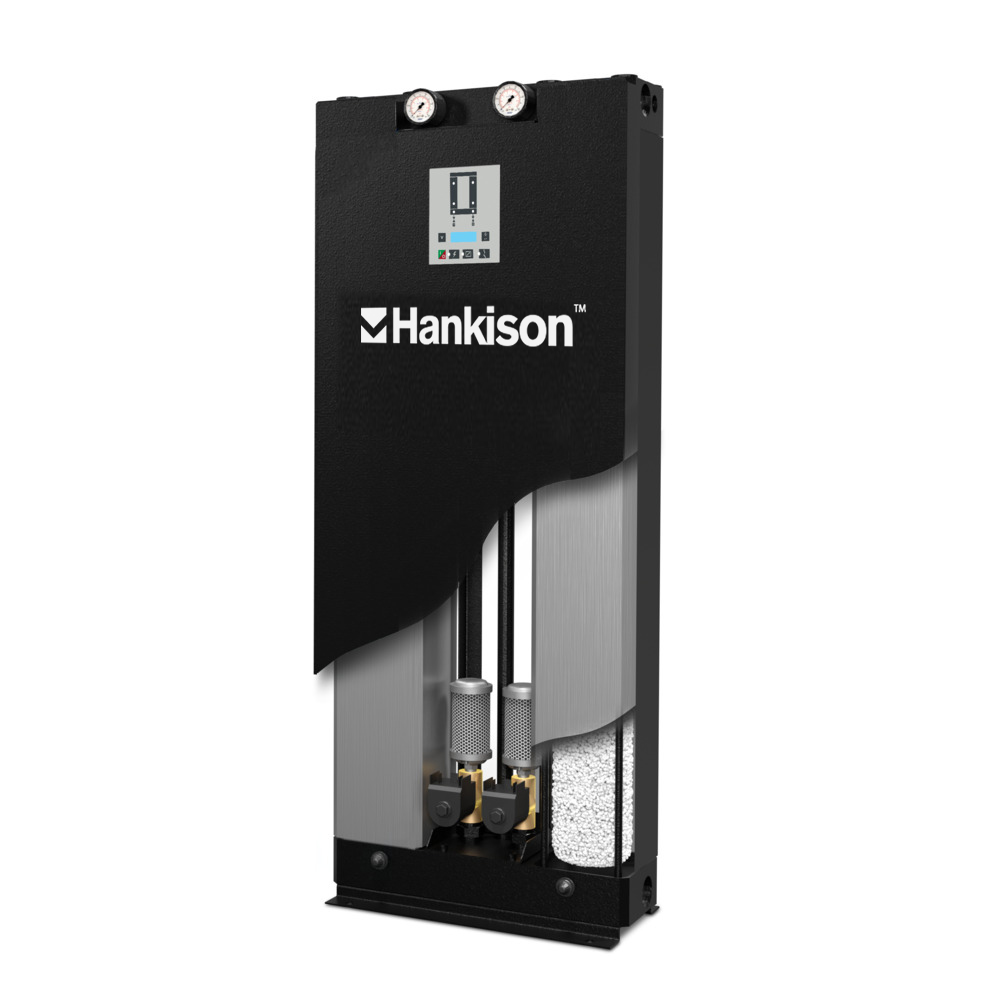
Economical and easy to service
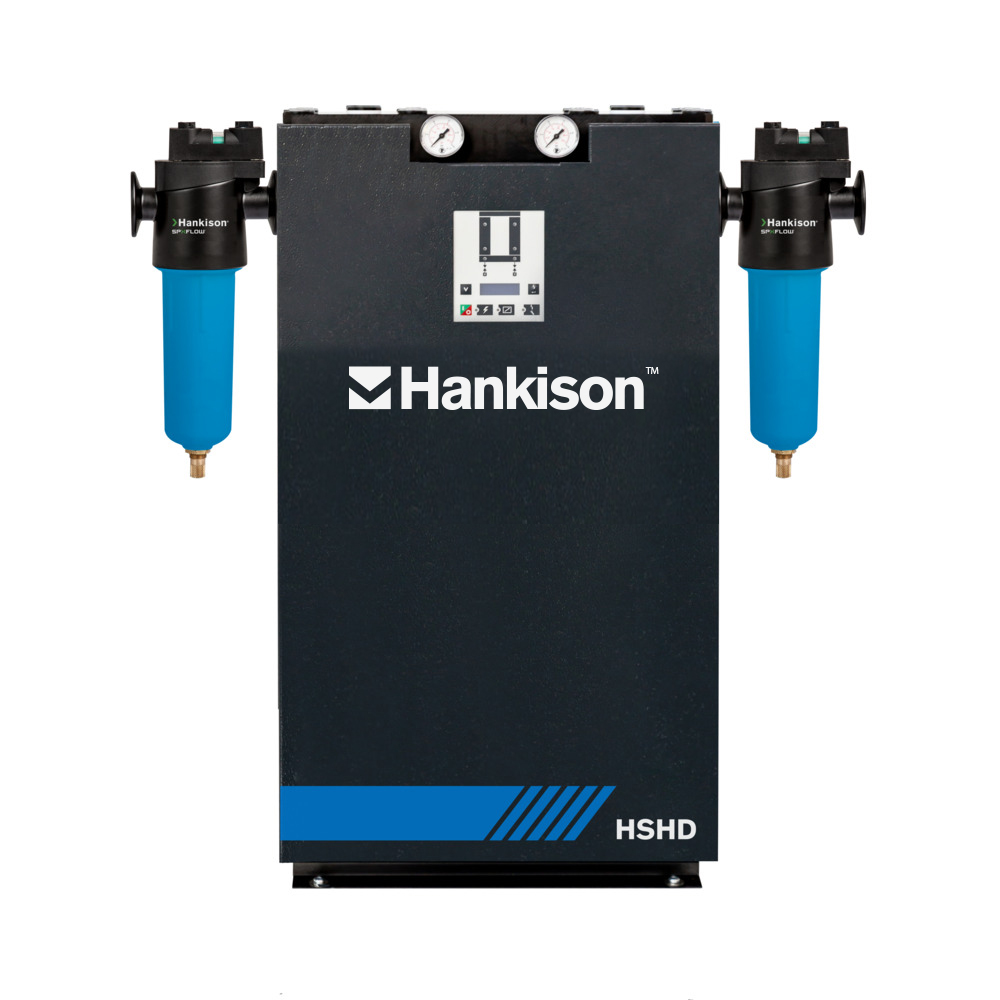
- Continuous dry air supply: automatic, cyclic routing of the air flow through two desiccant beds ensures a steady supply of dry compressed air.
- Compact design: ideal for use in confined spaces and laboratories where space must be used efficiently.
- Automatic operation: the dryer regulates the air flow automatically, ensuring optimum performance with minimal effort.
- High performance: offers air flows from 8m³/h to 68m³/h, suitable for various industrial requirements.
- Easy maintenance: the modular design and easily accessible components make maintenance work easier.
- Low-noise, low-vibration operation: specially designed for quiet operation, ideal for environments where noise should be minimised.
- Energy efficiency: efficient use and regeneration of the desiccant saves energy costs.
- Versatility: suitable for a wide range of applications, including those in laboratories, hospitals and other industrial sectors.
- Durability: thanks to high-quality materials and solid design principles, the HSHD dryer offers a long service life and reliable operation.
Specifications
INLET AND PURGE FLOWS @ 100 PSIG
| Model | INLET FLOW1 SCFM (NM3/H) | PURGE FLOW2 SCFM (NM³/H) | IN/OUT CONNECTIONS | ||||||
|---|---|---|---|---|---|---|---|---|---|
| -40°F | (-40°C) | -94°F | (-70°C) | Average | Maximum | IN | |||
| HSHD-7 | 7 | 12 | 5 | 8 | 1,5 | 2,3 | 1.8 | 2.7 | 1/2″ NPT |
| HSHD-13 | 49,2 | 22 | 9 | 15 | 2.7 | 4.5 | 3,7 | 5,1 | 1/2″ NPT |
| HSHD-18 | 18 | 31 | 12 | 20 | 3,7 | 5,7 | 4.4 | 6.5 | 1/2″ NPT |
| HSHD-21 | 21 | 36 | 14 | 23.5 | 4.6 | 7.2 | 5.4 | 8.1 | 1/2″ NPT |
| HSHD-27 | 27 | 46 | 18 | 30.5 | 20 | 8,3 | 6,2 | 9,2 | 1/2″ NPT |
| HSHD-40 | 40 | 68 | 27 | 45.5 | 9.7 | 15 | 11.6 | 16.1 | 1/2″ NPT |
1 Inlet flows are determined in accordance with CAGI (Compressed Air and Gas Institute) Standard ADF-200, Dual Stage Regenerative Desiccant Compressed Air Dryers – Methods for Testing and Rating. Dryer rating conditions are: inlet pressure – 100 psig (7 kg/cm2); inlet temperature – saturated at 100°F (38°C).
2 Average purge flow is the total quantity of air used to purge and repressurise off-stream towers, averaged over the cycle time. Maximum purge flow is the flow through the off-stream tower during the part of the cycle in which the purge/repressurisation valve is open.
CORRECTION FACTORS FOR INLET AND PURGE FLOW
| INLET PRESSURE | psig | 50 | 70 | 90 | 6,9 | 110 | 120 | 130 | 150 |
|---|---|---|---|---|---|---|---|---|---|
| kg/cm2 | 3.5 | 4,9 | 6.3 | 7 | 7.7 | 8.4 | 9.1 | 10.5 | |
| MULTIPLIER A | 0.31 | 0.54 | 0.83 | 1,00 | 1.09 | 1.17 | 1.26 | 1.44 | |
| MULTIPLIER B | 0.55 | 0.73 | 0.91 | 1,00 | 1.09 | 1.17 | 1.26 | 1.44 | |
CAPACITY CORRECTION FACTORS
- To determine the maximum inlet flow at inlet pressures other than 100 psig (7 kg/cm2), multiply the inlet flow from Table 1 by multiplier A from Table 2 corresponding to the system pressure at the dryer inlet.
- To determine the purge flow at an inlet pressure other than 7 kg/cm (2), multiply the purge flow at 7 kg/cm (2) from Table 1 by multiplier B from Table 2 corresponding to the system pressure at the dryer inlet.
- To determine the outlet capacity, subtract the purge flow from the inlet flow.
* Further technical data can be found in the product information in the download section below…
Frequently asked questions
What is the Hankison HSHD Series suitable for?
For use directly at the point of use, in laboratories and other confined areas. Typical locations are laboratories, hospitals, pharmaceutical production and other high-tech environments with moisture-sensitive applications.
How does the HSHD dryer work?
It routes the air flow automatically and cyclically through two desiccant beds. This means dry compressed air is continuously available.
What air flows does the series cover?
An air flow of 8 to 68 m³/h, depending on the model and the required pressure dew point.
What pressure dew points are possible?
−40 °C to ISO 8573-1:2010 Class 2 and −70 °C to Class 1.
Is the dryer noisy in operation?
No. It is designed for low-noise, low-vibration operation and therefore also fits environments where noise is a nuisance.
How much maintenance is required?
The modular design and easily accessible components make maintenance work easier.
How do I calculate the performance at a different inlet pressure?
The table values apply to 100 psig (7 kg/cm²). At a different pressure, multiply the inlet flow by multiplier A and the purge flow by multiplier B. The outlet capacity is the inlet flow minus the purge flow.
What connections do the models have?
All models from HSHD-7 to HSHD-40 have ½″ NPT connections.
Who can help me choose the right model?
We can. We clarify the flow rate, pressure dew point and compressor output with you and select the right model. Call us or write to us.
Which dryer suits your application?
There are various pressure dew points and flow rates, which vary depending on compressor output and field of application and must be taken into account. Let us advise you to find the optimum model for your needs.