

Conventional, variable speed or cycling refrigeration dryer – what are the differences?
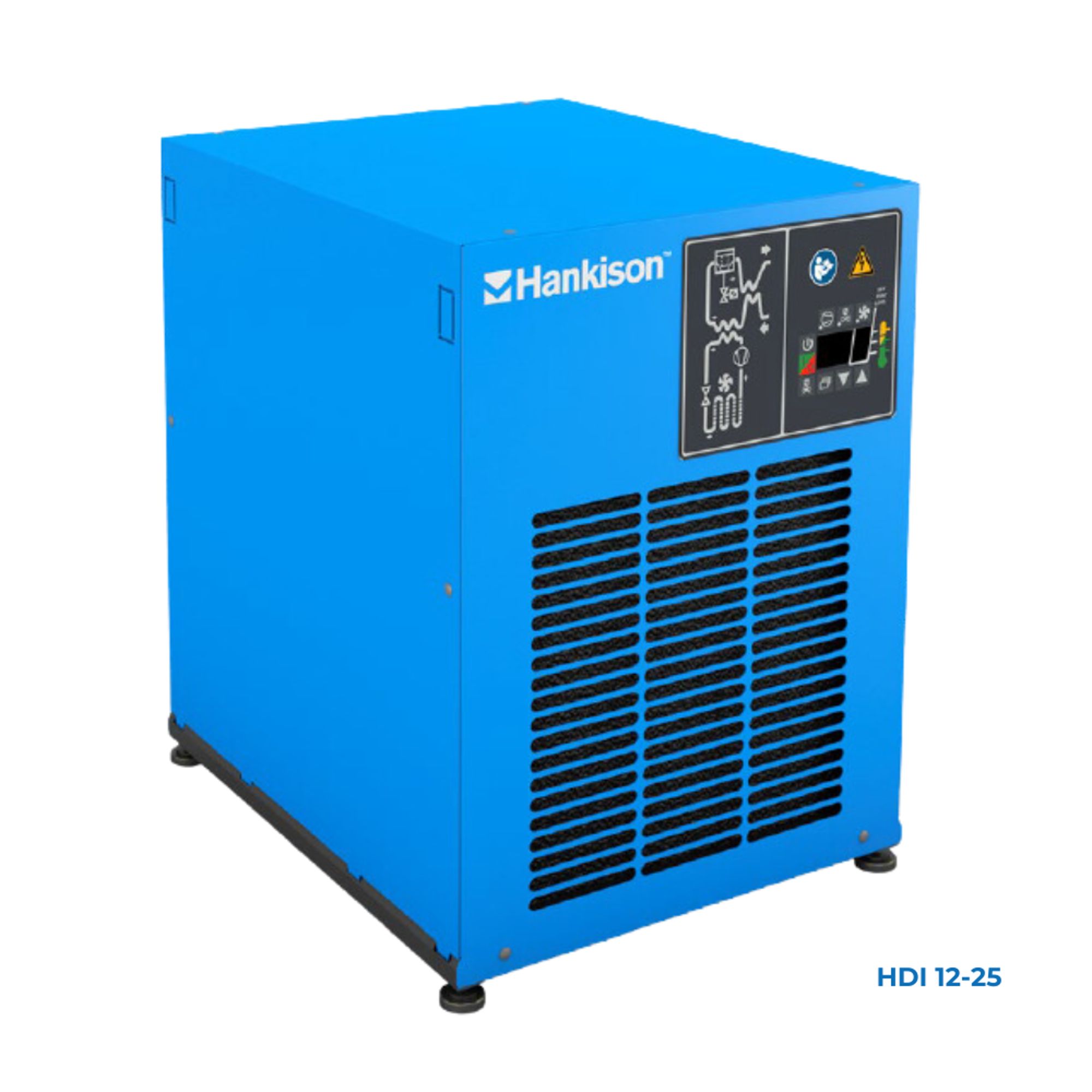
Anyone choosing a new refrigeration dryer today usually has a choice between three different technologies: the conventional refrigeration dryer, a variable speed model or a modern cycling refrigeration dryer such as the Hankison HDI-E series.
All three systems pursue the same goal: they reliably dry the compressed air to a pressure dew point of around +3 °C, protecting machines, piping and production processes from moisture. The decisive difference, however, lies in how this cooling capacity is generated – and this is exactly what determines how high the energy costs will be later on.
Variable speed refrigeration dryers – more efficient, but not optimal
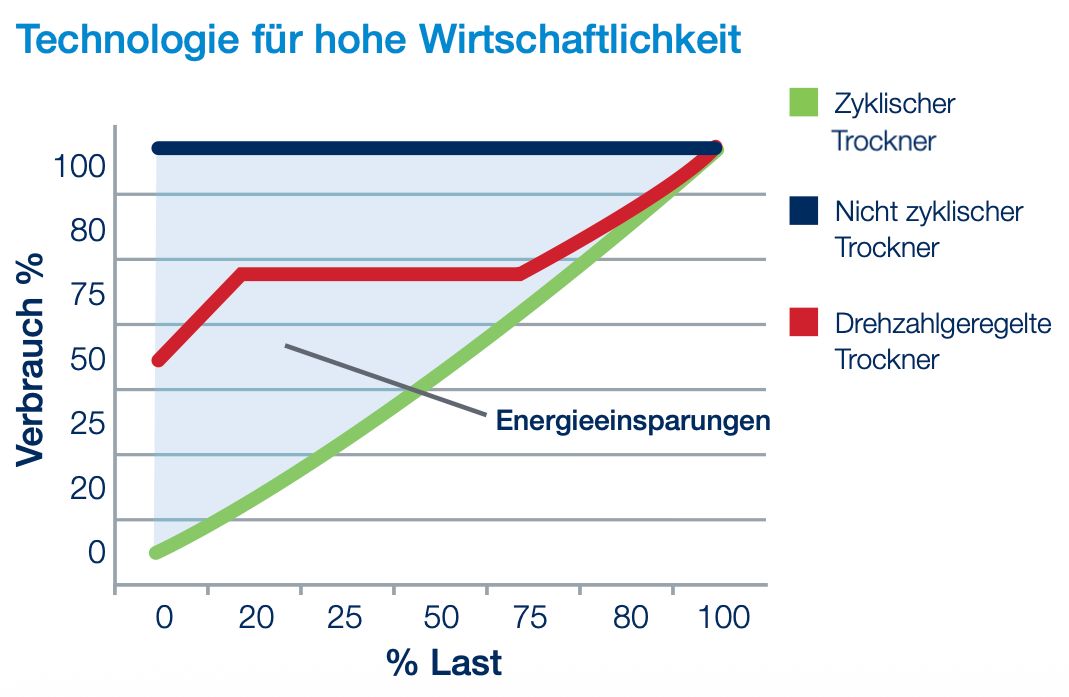
Variable speed refrigeration dryers are now regarded as a modern alternative to conventional units. Unlike a conventional refrigeration dryer, the refrigeration compressor does not run permanently at full power but automatically adjusts its speed to the current compressed air demand.
The Hankison HDI-E series takes a different approach
Instead of simply making the refrigeration compressor run more slowly, the Hankison HDI-E series works with an intelligent thermal storage system.
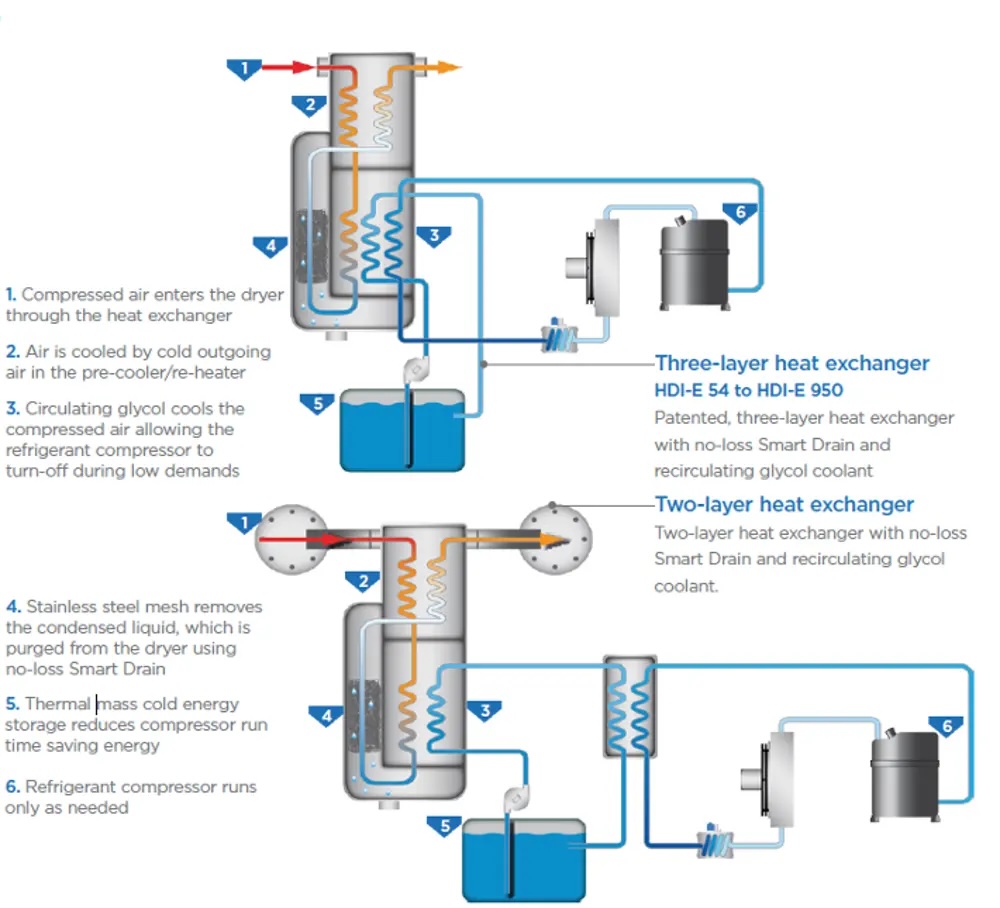
At high load, the refrigeration compressor generates more cold than is needed at that moment. This surplus cold is stored in a special glycol circuit.
When compressed air demand later falls, this cold storage takes over cooling the compressed air. During this time the refrigeration compressor stays completely switched off and only starts again when new cold is needed.
This cycling operating principle considerably reduces the running time of the refrigeration compressor and ensures that energy is only consumed when cooling capacity is actually required. At the same time, the pressure dew point remains constant and compressed air quality stays consistently high.
Further technologies deliver additional energy savings
The high energy efficiency of the Hankison HDI-E series is not based solely on its cycling operation. Several technical details help to reduce operating costs permanently.
Patented heat exchanger
The incoming compressed air is first pre-cooled by the already cooled outgoing air. As a result, the refrigeration compressor has considerably less work to do.
In addition, the patented aluminium heat exchanger ensures particularly efficient heat transfer and a low pressure drop. Less pressure drop also means a lower energy demand of the screw compressor.
Intelligent glycol circuit
The integrated glycol circuit stores surplus cold and releases it again at low load. As a result, the refrigeration compressor does not have to start up with every small change in load but works in longer, efficient cycles. This not only reduces electricity consumption but also spares the mechanical components of the refrigeration compressor.
Zero-loss electronic condensate drain
Many older refrigeration dryers use timer-controlled valves or simple float drains. These open regardless of whether condensate is actually present, and valuable compressed air often escapes unused into the open. The Hankison HDI-E series, by contrast, works with an electronic condensate drain that continuously monitors whether condensate is present. It opens only when needed, thus preventing unnecessary compressed air losses.
Practical example: a Swiss CNC joinery
To put the differences between the three technologies into perspective, let us look at a typical Swiss joinery with modern CNC production.
System configuration
Screw compressor
- Champion FM30RS
- Motor power: 30 kW
- Free air delivery 1.6 to 5.6 m³/min -> 336 m³/h max.
- Operating pressure: 8 bar
Refrigeration dryer
- Hankison HDI-E HDI360E for an air flow of up to 360 m³/h
- sized to match the maximum flow rate of the Champion FM30RS
Operating profile
Production takes place:
- Monday to Friday
- 10 hours a day
- 50 production weeks per year
This results in:
- 2,500 production hours per year
- 6,260 hours in standby mode
During standby time, the compressed air system remains under pressure. Due to unavoidable leaks, around 8% of the maximum free air delivery is required.
These operating conditions are typical of many Swiss SMEs and are ideal for an example calculation.
The biggest savings are made outside production
At first glance, 8% leakage air seems negligible. In fact, however, the compressed air system spends over 70% of the entire year in exactly this operating state.
This is where the three technologies differ most clearly.
While a conventional refrigeration dryer keeps working almost continuously, and even a variable speed unit usually cannot switch off the refrigeration compressor completely because of its limited control range, the Hankison HDI-E series makes use of its integrated cold storage. As a result, the refrigeration compressor stays completely switched off for longer periods.
It is precisely these many hours at low load that allow the investment in a cycling refrigeration dryer to pay for itself within just a few years.
Comparison of annual electricity costs
The following example calculation is based on an average Swiss industrial electricity price of CHF 0.25 per kWh.
| Technology | Annual electricity costs |
| Conventional refrigeration dryer | approx. CHF 2,100 |
| Variable speed refrigeration dryer | approx. CHF 1,250 |
| Hankison HDI-E | approx. CHF 600 |
Compared with a conventional refrigeration dryer, this example gives annual savings of around CHF 1,500. Even compared with a modern variable speed unit, the Hankison HDI-E series cuts electricity costs by a further CHF 650 per year or so.
Over the entire service life of a refrigeration dryer, this adds up to considerable savings potential – especially as energy prices rise.
Annual electricity costs of the refrigeration dryer
Operating profile of the example system
The two charts clearly show why modern cycling refrigeration dryers pay off above all in companies with variable production: it is not the production time that determines cost-effectiveness, but the many hours at low load in which conventional systems use energy unnecessarily.